
Shapes
6 min read
Almond shape nails

By Andreea Mădălina
Founder, Fata cu unghiile
Almond is a frequently requested nail shape in upmarket Romanian salons. It tends to read as elegant, suits a wide range of hand types, and is achievable on natural nails of moderate length. The silhouette tapers from a wider base toward a softly pointed tip, like the outline of an almond seen from one side. It often comes across as feminine and considered without feeling fussy, which is part of why it's a common choice for bridal and event work. This article covers what almond shape is, who it tends to suit, how it differs from related pointed shapes, and how to ask for it.
What it is
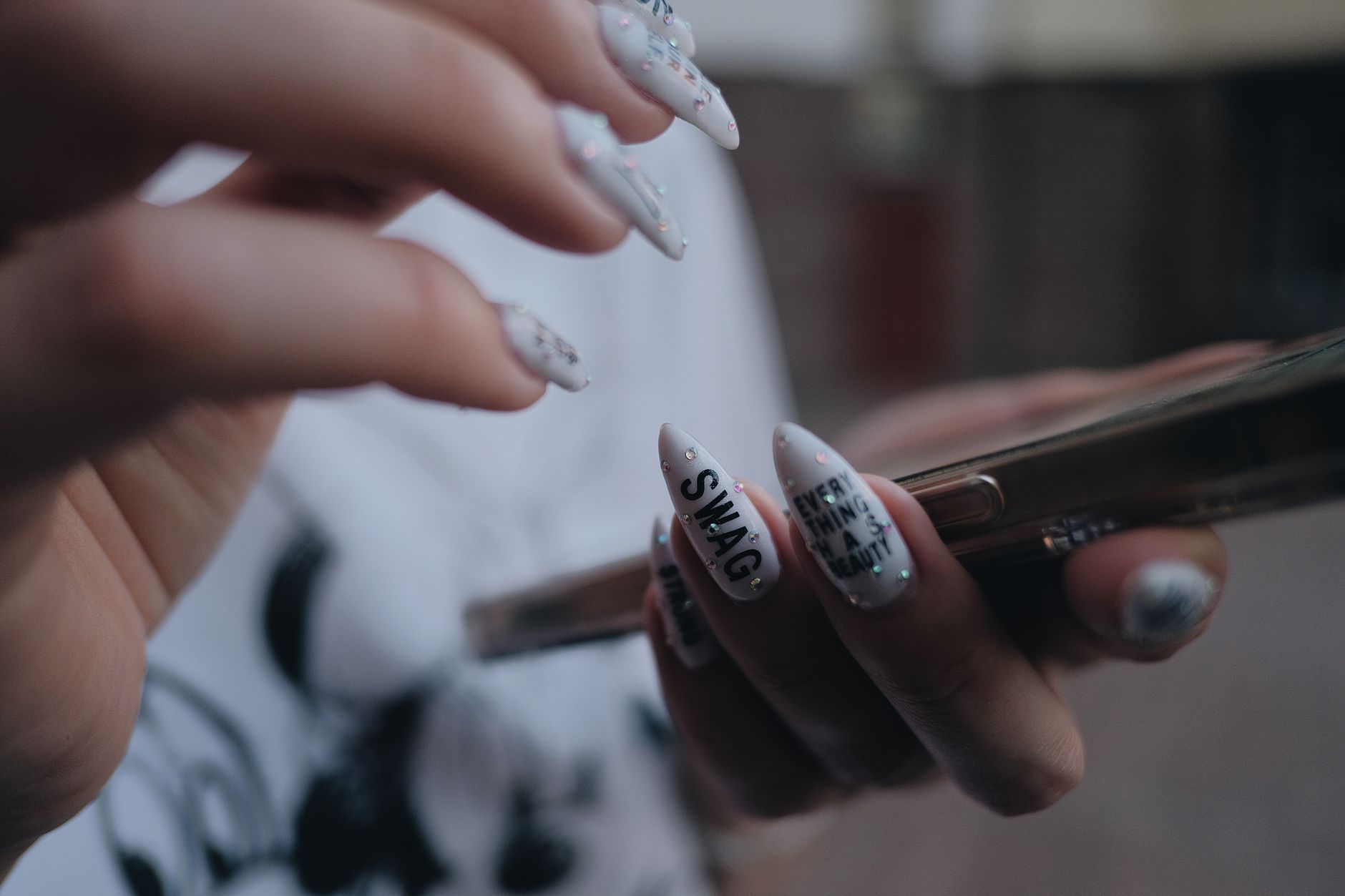
Almond shape (forma migdală) is a tapered nail shape with rounded sides that converge toward a softly pointed tip. The width at the cuticle is the natural width of the nail bed, and the nail narrows gradually outward to a tip that's slightly pointed but not sharp.
The defining feature is the gentle taper. Stiletto nails taper much more aggressively to a sharp point. Oval nails round into a curve at the tip with no pointing. Almond sits between the two, with enough taper to look elegant and enough roundness to look soft.
A well-shaped almond should have symmetrical sides, a tip that points slightly toward the centre of the finger rather than off-axis, and overall length proportional to the nail bed.
Who it suits
Almond tends to suit:
Long fingers and slim hands particularly well. The tapered shape can echo the proportion.
Medium to long nail beds. Almond needs some length to develop the shape; on very short nails the taper has little space to happen.
Nails that grow in a slightly elongated shape naturally. The shape often works well with this proportion.
People who want their fingers to look longer in photographs. Almond can do this visually more than rounded shapes do.
It tends to be less ideal for:
Very short nail beds. Forcing almond on short nails creates a stubby look that fights the intended elegance.
Nails that grow wide rather than long. The taper can make wide nails look less proportional.
Hands-on work that requires gripping or precision. The tapered tips catch on fabric, can chip easier than rounded shapes, and aren't as practical for typing or fine motor tasks.
How it differs from related shapes
A few related pointed shapes worth knowing:
Stiletto is more dramatically tapered, with a sharp point. Bolder, more editorial, more high-maintenance because the points crack and break.
Mountain peak (lipstick) has a single angled cut at the tip rather than a centred point. Different visual but similar tapered family.
Coffin / ballerina is square at the tip with tapered sides. Tapered base, flat top.
Oval is rounded all the way around without any pointing. Softer alternative to almond.
If you want elegance and femininity without going to the extreme of stiletto, almond is the answer. If you want softer than almond, oval is the answer.

What to expect at the appointment
Filing almond shape tends to be more involved than oval or square. A few things the artist generally aims for:
Symmetrical sides. The taper should ideally be even on both sides of each nail; uneven tapering is a common visible error.
A centred point. The tip should align with the centre line of the finger; off-centre points can make the whole hand look slightly crooked.
Consistency across all ten nails. Each finger has a slightly different nail bed width and length, so the artist generally compensates to keep all ten almonds in the same visual family.
Light filing. Aggressive filing can weaken the side walls; almond tends to be less robust than rounded shapes, so a lighter touch usually holds up better.
The shaping itself adds 10-20 minutes to a manicure compared to a square or oval finish, especially on a new client whose existing shape needs adjustment.
Who shouldn't choose almond
A few honest counterpoints:
If your nails are weak or chronically peeling, almond's tapered tips can break more easily than rounded shapes. Square or squoval tends to distribute pressure better.
If you work with your hands intensively (cleaning, gardening, manual trades), almond can be impractical. The tips can catch and crack, and the cost of repairs may add up.
If your nail bed is short, almond is harder to develop properly. Force-filing the shape on short nails can look awkward.
If you've never had longer nails before, almond may take some adjustment. The tapered tips change how you use your hands, and adjusting can take a couple of weeks.
What it costs
Prices below are approximate ranges as of 2026. Treat them as orientation rather than authoritative; check with the specific salon for current pricing.
Almond doesn't usually carry a price premium over other shapes. The cost difference between almond, oval, and square is generally small.
The actual cost is in the underlying service. Almond on natural nails with semi-permanent typically runs the same as any other semi-permanent in your city. Almond on gel construction varies based on length, since longer almonds require more gel.
Some salons charge a small premium for elaborate shapes (sharp stiletto, very long almond) because of additional shaping time. This isn't universal but is worth asking about.
Care notes
Same as any manicure, with a few almond-specific points:
The pointed tip is more vulnerable to catching than rounded shapes. File any rough edge smooth between appointments.
If you crack a tip, file the entire nail back to a slightly shorter almond rather than letting the crack propagate. Small damage caught early is much easier to manage.
When opening packages or working with hands, use the pad of the finger rather than the tip. Tapered shapes don't lever well.
Cuticle oil is the same routine as any manicure.
Common questions
Is almond a healthy shape for natural nails?
In moderation, yes. Aggressive filing to create extreme almond tapering on weak natural nails causes side-wall thinning. Moderate almond on healthy nails is fine.
How long should my nails be for almond?
At least 5-7 mm of free edge past the fingertip works for a basic almond. More dramatic almond shapes need 8-12+ mm. Very short nails (under 5 mm) don't accommodate almond well.
Yes, generally more than rounded shapes do. The visual taper tends to extend the apparent length of the finger.
How is almond different from stiletto?
Stiletto has a sharper, more dramatic point. Almond is the softer family member. Almond tends to read as "elegant nails," while stiletto reads as "edgier nails."
Can I do almond at home?
Filing almond well takes practice. Symmetry is hard to achieve with hand-held files. For your first almond, salon work is worth the cost. Once you know the shape on your nails, home maintenance between appointments is easier.
My almond nails keep cracking. What might be going on?
Several factors can play a role: nails too long for the structural strength they have, tips that are too sharp (over-tapered), side walls that are thin, using nails as tools, or underlying gel construction without enough apex support. An experienced manicurist can usually help identify which factors are most relevant for your specific situation.
Can I get almond over short natural nails using gel construction?
Yes. Construction adds the length needed to develop the almond shape. This is a common reason people book gel construction.
Bottom line
Almond can be a good default for medium-to-long nails. It tends to work well for daily wear, suits events, photographs nicely, and reads as considered and feminine without overstating itself. Finding a manicurist whose almond work in your preferred length looks symmetrical and proportional is generally the most useful step.