
Techniques
9 min read
Marbling nail technique

By Andreea Mădălina
Founder, Fata cu unghiile
Marbling covers a small family of techniques that produce swirled, organic patterns on the nail rather than flat colour or sharp graphic art. The look tends to read as romantic and painterly, closer to a small piece of artwork than to a styled finish. It has been a familiar offering in Romanian salons for several years, often booked as a feature on a few accent nails or as a full set for an event where something visually distinctive matters.
This article covers what marbling actually means in the nail context, the three main approaches you'll see in salons, the variations that have become popular, and what to expect on time and cost.
What it is
Marbling is any technique that produces a swirled, blended, non-uniform pattern on the nail, usually evoking the look of natural marble, ink in water, or watercolour. The defining feature is the organic, irregular flow of colour. Where ombre transitions in one direction, marbling tends to swirl, fold, and meander.
The pattern can be subtle (soft white veining on a nude base, in the style of polished stone) or dramatic (deep jewel tones swirling together over a black base). Marbling sits closer to nail art than to a standard finish, and most artists treat it that way in pricing and time.
What it isn't: marbling isn't ombre, despite both being blended techniques. Ombre transitions colour in a controlled direction. Marbling is intentionally irregular. It also isn't chrome or foil work; those produce mirror-like or metallic effects through different methods entirely.
A few terms worth knowing. Marble nail art is the umbrella term used in Romanian salons. Water marble, dry marble, and alcohol ink refer to the three main techniques covered below. Stone marble and pearl marble are popular variations.
How it's done
Different artists prefer different methods, and the same artist may switch between methods depending on the look the client wants. The three main approaches:
Water marbling. The older and more traditional method. The artist drops several colours of polish onto the surface of room-temperature water in a small cup, where the polish floats and spreads into thin films. They then use a fine tool to drag the colours into a swirled pattern on the water's surface. The nail is dipped through the pattern, and the polish film transfers to the nail. The technique is genuinely difficult and time-consuming. Polish chemistry, water temperature, room temperature, and timing all matter. Less common in modern Romanian salons because the alternatives below are usually faster and more reliable, but some artists still prefer it for the specific look it produces.
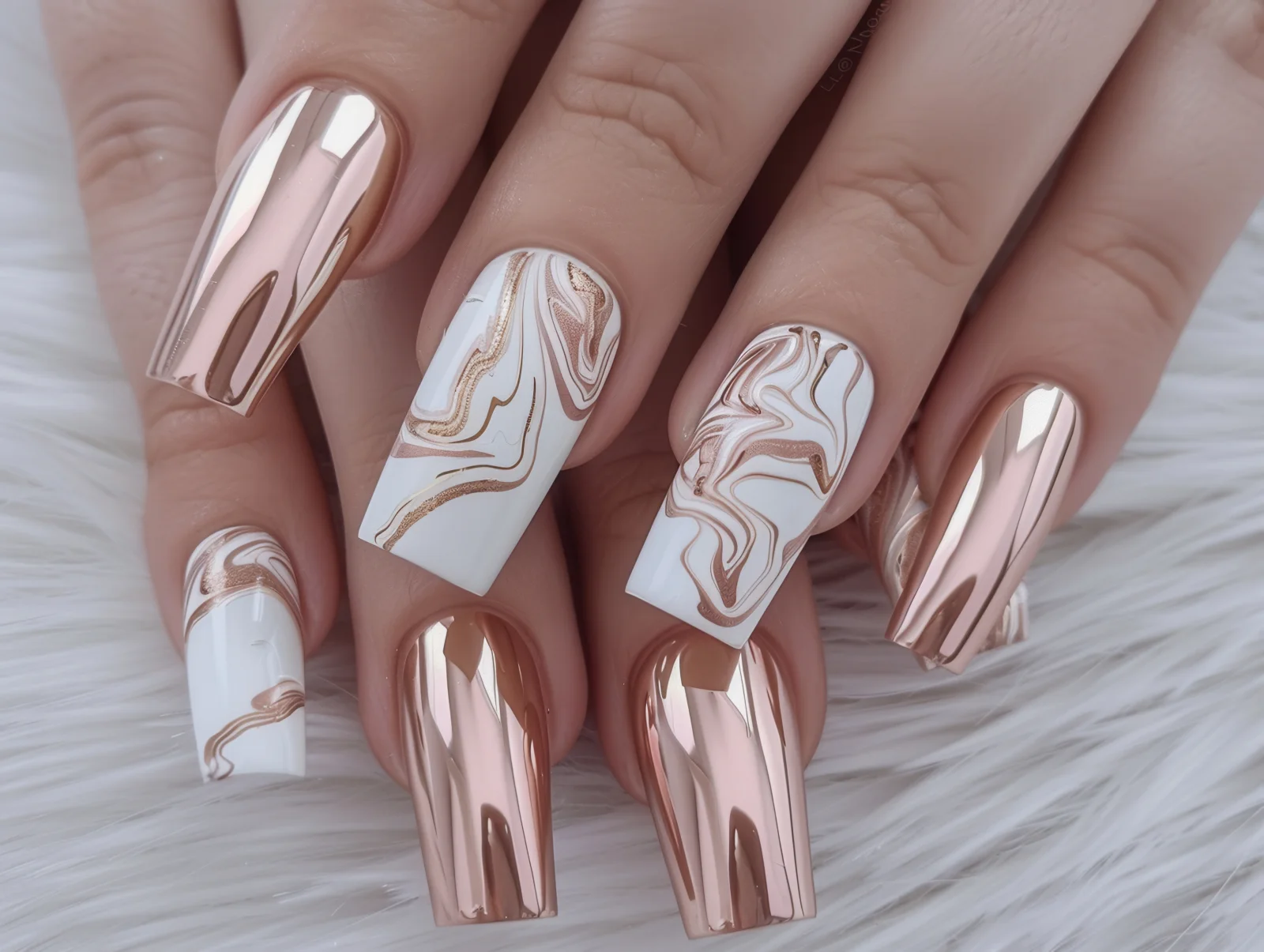
Alcohol-ink marbling. A newer method, increasingly common for soft, ethereal looks. The artist applies a base colour (often white, nude, or a pastel) and cures it. They then place small drops of alcohol ink onto the surface. The ink spreads and reacts with the base, producing soft, watercolour-like patterns with characteristic feathery edges. The artist may guide the spread with a fine brush or compressed air. After the ink dries, a clear top coat seals everything. The result tends to look more like watercolour painting than polished stone. Particularly suited to subtle, romantic looks.
Whichever method, marbling is time-intensive. Adding marbling to a base service typically extends the appointment by 30 to 60 minutes, depending on the complexity, the number of nails being marbled, and the artist's chosen method.
Marbling can be applied as standalone art across all ten nails, as accent nails alongside a plain or French finish, or as a feature over an existing French structure (where the marbling sits on the bed of the nail and the white tip is left clean).
How long it lasts
Typically the same as the underlying service. Two to three weeks for semi-permanent, three to four weeks for gel construction.
The visual life of marbling depends on the colour combination and the pattern's complexity. Subtle, low-contrast marbling (such as pearl marble or stone marble in nude tones) tends to age gracefully because regrowth at the cuticle blends into the existing pattern rather than disrupting it. Higher-contrast marbling (jewel tones, dark colours, sharp pattern lines) can show regrowth more prominently at the cuticle.
A clear top coat refresh at week two can restore gloss and depth, particularly on alcohol-ink work where the surface can feel slightly less reflective as it ages.
Who it's for
Marbling can be a good choice when:
You want something visually distinctive but still wearable. Marbling reads as art without being a bold graphic statement.
You like the idea of nail art but find figurative work (flowers, characters, geometric patterns) too much. Marbling is abstract.
You have a specific event or photo opportunity coming up. The patterns photograph well and tend to look striking in macro shots.
You're booking a longer appointment anyway, since marbling adds significant time.
You enjoy the slight unpredictability of the pattern. Each nail is genuinely unique, and that's part of the appeal.
It may not be the right fit when:
You want exact symmetry or matched-set precision. Marbling is intentionally irregular, and no two nails will be identical.

You're sensitive to longer service times in general, or you find sitting still through detailed work uncomfortable.
You want something subtle in a literal sense. Even soft marbling has more visual texture than a single colour.
What it costs in Romania
Prices below are approximate ranges as of 2026. Treat them as orientation rather than authoritative; check with the specific salon for current pricing.
Marbling is typically priced as an addition to a base service rather than as a standalone service. In Bucharest, marbling commonly adds roughly 50 to 100 RON over the base manicure or gel construction price, depending on the technique, the number of nails marbled, and the complexity of the pattern.
For comparison, semi-permanent in Bucharest typically falls in the 120 to 180 RON range, and gel construction roughly 200 to 280 RON, so a full set with marbling on every nail tends to land in the 200 to 380 RON range overall.
Outside Bucharest, prices generally trend lower, with smaller cities often 20 to 35% below.
Water marbling sometimes carries a small additional charge over dry marbling because of the time involved. Some artists also charge per accent nail rather than as a flat addition; worth confirming when booking.
What to ask your artist
A few questions specific to marbling:
Which method do you use, and why? Water, dry, or alcohol ink. Each produces a slightly different aesthetic. Many artists work in only one or two of the three. If you have a specific reference photo, asking which method matches the reference is useful.
Can I see recent marbling work in colour combinations similar to what I want? Marbling skill varies meaningfully by colour pairing and by method. Soft nude marbling and bold jewel-tone marbling are quite different in execution. Portfolio examples in your colour territory are the most reliable signal.
Will you marble every nail or use accent nails? Worth clarifying upfront. All-ten marbling reads differently from one or two accent nails alongside a plain finish.
Can I bring inspiration photos? Almost always welcome. Marbling is hard to describe in words; reference photos clarify pattern density, colour balance, and overall mood.
How long will the appointment take? Marbling adds significant time. A realistic answer for a full set tends to land in the 90 to 150 minute range total, depending on the base service and the technique.
If the first nail looks meaningfully different from the reference or from what you wanted, it's reasonable to mention it before the polish cures. Adjustment during application is much easier than fixing after.
Care between appointments
Same as the underlying service. For the broader maintenance practices, see healthy nails fundamentals.
The top coat layer matters more on marbling than on flat finishes, since the pattern depth and gloss come partly from the clear coat sitting over the work. A top coat refresh mid-cycle can restore visual depth if the surface starts looking less reflective.
Avoid oils, hand creams, and acetone-based products immediately after the appointment, since these can interact with alcohol-ink work specifically while it cures. Most artists will mention this if it applies.
Common questions
What's the difference between stone marble and regular marbling?
Stone marble is a specific style within the marbling family, designed to mimic the look of polished natural stone. White or grey base with fine darker veining (true marble), or warmer beige with veining (granite or travertine). The technique is usually dry marbling with a very fine brush for the veining. Regular marbling can be any colour combination and any pattern density.
What is pearl marble?
A subtle variation, usually soft white veining or swirling on a nude or pale pink base, often with iridescent or pearlescent finishing. Reads as understated and bridal-friendly. Particularly suited to alcohol-ink technique.
Can I do marbling at home?
Possible but difficult to execute well. Water marbling kits are widely available and home results are typically recognisable as home work. Dry marbling on regular polish is more achievable with practice. Alcohol-ink marbling generally requires gel and a UV or LED lamp, so it tends to be a salon-only technique. For events that matter, salon work is usually worth the cost.
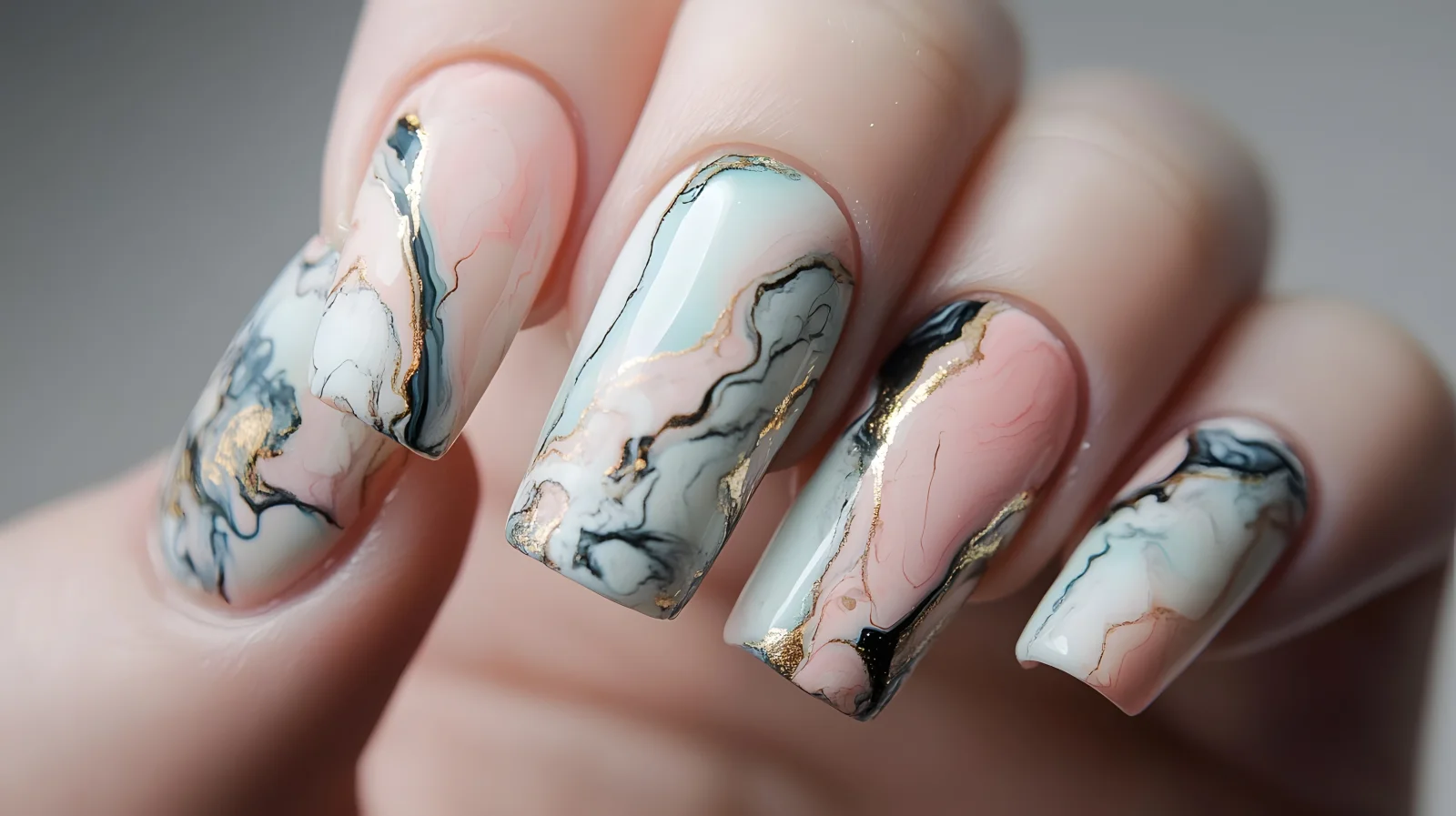
No, and that's part of the look. Each nail is marbled individually and the pattern is intentionally irregular. A skilled artist can keep the colour balance and pattern density similar across all ten, but exact replication isn't the goal. If matched-set precision matters to you, marbling may not be the right choice.
Does marbling work over French?
Yes. Marbling on the nail bed with a clean French tip is a popular combination. The marbled section sits in the natural-coloured area and the white French tip stays untouched. Adds time over a standard French.
Does it photograph well?
Often yes. Marbling tends to reveal more detail in macro photography than the eye picks up at conversational distance, which is part of why it's popular on Instagram. Lighting matters more than for flat finishes.
Why does my marbling look different from the reference photo?
Several factors. The exact polishes or inks used affect colour and flow. Lighting in reference photos is often professional. The base nail length and shape affect how the pattern reads. A skilled artist can typically get reasonably close to a reference, but perfect replication is uncommon and not really what marbling does.
Bottom line
Marbling can be a good choice when you want something painterly and visually distinctive without committing to figurative nail art. The three methods (water, dry, and alcohol ink) each produce a slightly different aesthetic, and finding an artist whose preferred method matches the look you want tends to be the most useful step. Expect the appointment to run longer than usual, and expect the result to be genuinely unique to your hands rather than a perfect match to any reference.