
Shapes
7 min read
Square shape nails

By Andreea Mădălina
Founder, Fata cu unghiile
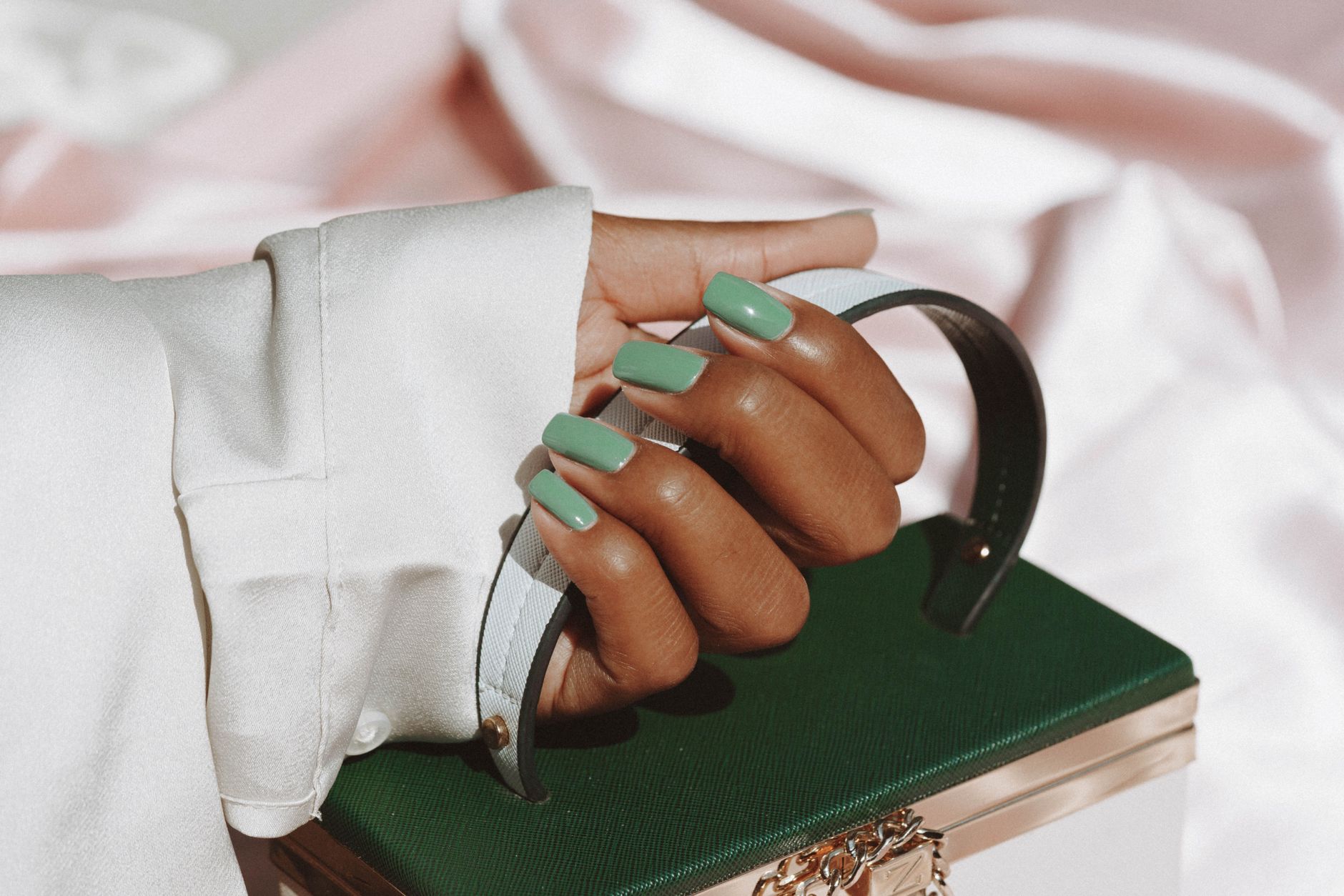
Square is a structured, modern, slightly editorial shape. Sides run straight from the cuticle to the tip with no taper, the tip is flat, and the corners are sharp or only slightly softened. The look tends to read as bold and deliberate, and is often associated with certain aesthetic moments (minimalist, fashion-forward, particular Instagram styles). It doesn't suit everyone, but for the people it does, the architectural feel is hard to replicate with other shapes.
This article covers what square shape is, who it suits, how it differs from squoval and coffin, and the practical considerations of wearing flat-tipped nails.
What it is
Square shape (forma pătrată) is a flat-tipped nail with parallel sides. The width at the cuticle and the width at the tip are the same. The tip itself is filed flat, perpendicular to the sides, creating a shape that looks like a rectangle with a slight curve at the bottom.
The corners can be:
Fully sharp — straight angles where the sides meet the tip. The most modern look, but corners catch easily and chip.
Slightly rounded — sometimes called "soft square" or sometimes confused with squoval. Same flat top but with the corners slightly filed to reduce catching.
The defining feature is the flat top with straight sides. Any taper or any rounding at the tip moves it into squoval or oval territory.
Who it suits
Square tends to be most flattering on:
Long nail beds where the parallel sides have room to develop visually.
Slim fingers where the structural shape can add visual interest.
Anyone going for a modern, minimal, or editorial look.
People with relatively strong nail beds. Square distributes pressure across the flat tip, but the corners can be vulnerable to chipping if the underlying nail is weak.
It tends to be less flattering on:
Wide nail beds. Square can make wide nails look chunkier than other shapes do.
Short nail beds. Square generally needs some length to develop the rectangular silhouette; on very short nails it can look like a clipped natural nail rather than an intentional shape.
Curved natural nail beds (where the nail grows with strong side curl). The flat tip can look forced if the underlying nail is dramatically curved.

How it differs from related shapes
Three close relatives:
Squoval is square with rounded corners. Same flat top, softer overall feel. A frequently chosen middle-ground shape.
Coffin / ballerina has tapered sides ending in a flat tip. Combines tapered base of almond with flat tip of square.
Round has the same width as square but with a curved tip. Different feel entirely.
Square is the structured, modern, somewhat-formal end of the rounded-vs-pointed spectrum. Oval is the soft middle, almond is the elegant taper, square is the architectural straight.
What to expect at the appointment
Square tends to require precise filing:
The sides should be as parallel as possible. Visible taper or flare can make the shape read as something else.
The tip should be roughly perpendicular to the sides. An obvious angle can look unintentional.
The corners need consistent treatment across all ten nails. Sharp on all, slightly rounded on all, or whatever variation you've agreed on.
Length should be consistent. Square tends to emphasise any length variation across nails because the flat top can make height differences more visible.
Filing time is similar to oval but generally with more attention to precision.
A common error: filing the sides into a slight taper while believing they're parallel. Optical illusions can make this hard to see. Experienced artists often use straight reference tools (a flat edge or grid) to verify parallel sides. Less experienced ones may eyeball it and produce square-but-slightly-tapered shapes that don't quite read as square.
Practical considerations
Square tends to be more high-maintenance than rounded shapes:
The corners can catch on fabric, hair, and other textures. Snags can chip the corner or even break it off.
The flat tip can emphasise any length difference between nails. Growth between appointments may look more uneven on square than on rounded shapes.
Sharp corners can scratch your face, contact lens insertion may be harder, and some manual tasks can be awkward.
Square nails don't typically dent or smudge during application more than other shapes, but the flat tip can be more vulnerable to chipping at the corners during the first 24 hours.
What it costs
Prices below are approximate ranges as of 2026. Treat them as orientation rather than authoritative; check with the specific salon for current pricing.
Square is typically priced the same as other standard shapes. Most salons don't charge a premium for square specifically; the underlying service generally determines cost.
A few salons charge a small premium for very precise architectural shapes (very sharp square, very long square) because the additional precision can add time. This isn't widespread.
Who shouldn't choose square
A few honest counterpoints:
If your hands take regular wear (typing, handling fabric, manual work), square corners can chip and snag more frequently than rounded shapes. The maintenance trade-off may not be worth it for some people.
If you have weak natural nails, square's corners tend to be the most likely failure points.
If your hand shape is wide and short, square may emphasise rather than flatter the proportion.
If you change shape often, square can be harder to switch from than rounded shapes. The flat tip means filing into a different shape often requires significant length removal.
Care notes
Same as any manicure with extra attention to corners:
File any rough corner edge smooth immediately. A small chip propagates fast on square shapes.
Keep nails consistent in length. Length variation shows more on square than on rounded shapes.
Use the pad of your fingertip rather than the corner for tasks that involve picking or scraping.
Cuticle oil and standard maintenance routine apply.
Common questions
Is square going out of fashion?
Square cycles in and out. As of 2026, soft square (rounded corners) is more popular than fully sharp square. Fashion-forward Instagram is showing more sharp square than mainstream salons. Both are valid; the choice is taste.
Will square make my fingers look shorter?
Slightly. The flat tip compresses the visual length of the nail. If finger-lengthening is your goal, almond or oval is better.
Why do my square nails keep chipping at the corners?
Several factors can play a role: the corners may be too sharp (slightly rounding can help), the underlying nail may be weak (a builder gel or strengthening base may be worth discussing with the artist), the lifestyle may be rough on the tips (squoval can be a more forgiving alternative), or the artist's filing technique may be leaving the corner unfinished. An experienced manicurist can usually help identify which factors are most relevant for your specific situation.
Can I do square at home?
Yes, with care. The challenge is keeping the sides parallel and the tip flat. A glass file with a flat edge helps. Filing one nail at a time, checking against a reference, gives the best result.
Is square the same as squoval?
No. Square has fully sharp corners. Squoval has rounded corners. Many salons casually refer to soft-cornered square as squoval and vice versa, but technically they're different shapes.
Can I do French on square nails?
Yes. The smile line follows the natural curve of the nail bed regardless of tip shape. French on square is a classic combination.
What polish suits square best?
Bold colours and modern styles often work well. Deep reds, blacks, chromes, and minimalist designs tend to complement the architectural shape. Soft pastels can also work; very glittery or fussy designs sometimes feel like they're fighting the structure rather than working with it.
Bottom line
Square can be a good choice for a deliberate, modern, structured look on nail beds with the length and strength to support it. It tends to be higher-maintenance than rounded shapes, but for some people the distinctive aesthetic is worth the trade-off. If you want something softer or more practical, squoval gives you much of the visual with fewer of the catching issues. Finding an artist who can file truly parallel sides is generally the most useful step.