
Techniques
10 min read
Hand-painted nail art

By Andreea Mădălina
Founder, Fata cu unghiile
Hand-painted nail art is exactly what it sounds like: an artist literally paints designs onto each nail with fine brushes, dotting tools, and gel paint, building the image stroke by stroke. It sits at the more variable end of the nail-art spectrum — the result depends heavily on the individual artist's drawing skill, and two practitioners working from the same reference photo can produce noticeably different finishes.
This article covers what hand-painted nail art is, how the technique is carried out, the kinds of designs it suits best, what to look for in an artist, and what to expect on time and cost.
What it is
Hand-painted nail art covers any design painted directly onto the nail by an artist, rather than created using stamps, stickers, decals, water transfers, or pre-printed nail wraps. The medium is usually gel paint — a thicker, more pigmented version of standard gel polish that holds its shape under a fine brush — applied between a base coat of colour and a clear top coat that seals the design.
It is the most artist-dependent technique covered in this knowledge base. With ombre or baby boomer, technique varies but the underlying structure is broadly the same; with hand-painted work, the artist's drawing ability is the entire product. Skill ranges enormously across practitioners, from artists who can reproduce a complex floral from a reference photo with confidence to those whose comfort zone is limited to a few familiar motifs.
What it isn't: hand-painted nail art is distinct from stamping (where designs are transferred from etched plates), from decals and water slides (pre-printed images applied to the nail), and from airbrushed work. Some salons combine these techniques — a stamped outline filled in by hand, for example — but pure hand-painted work means the design is drawn freehand or to a light pencil sketch.
How it's done
After the underlying manicure or gel construction is finished and the base colour is cured, the painting stage begins.
Gel paint and brush selection. Gel paint comes in a wider colour range than gel polish, with thicker viscosity that lets a brush hold its shape. Artists typically work with a small palette of colours laid out on a silicone mat or piece of foil, mixing shades as needed. Fine-tip brushes (often called liner or detail brushes) handle outlines and small marks; slightly broader flat or oval brushes handle fills and shading. Many artists also keep a dotting tool — a metal stylus with a small ball at the tip — for clean dots, flower centres, and small repeated marks.

Sealing. Once the design is complete, a clear gel top coat seals everything. Top coat over hand-painted work needs care: applying it too aggressively can drag the design before it cures. Many artists float a thin first layer over the painted area, cure it, then add a second top coat for full gloss and protection.
Hand-painted nail art typically adds 60 to 180 minutes to a standard semi-permanent or gel construction appointment, depending on the complexity of the design and how many nails carry it. A single accent flower on one nail is much faster than a full set with detailed work on every finger.
What kinds of designs
Hand-painted work can in principle reproduce anything, but a few categories come up most often in Romanian salons:
Florals. Roses, daisies, cherry blossoms, abstract petal arrangements. One of the most-requested categories. Style ranges from delicate, watercolour-like washes to bolder, defined botanical illustrations. Often used as accent work on one or two nails rather than across the full set.

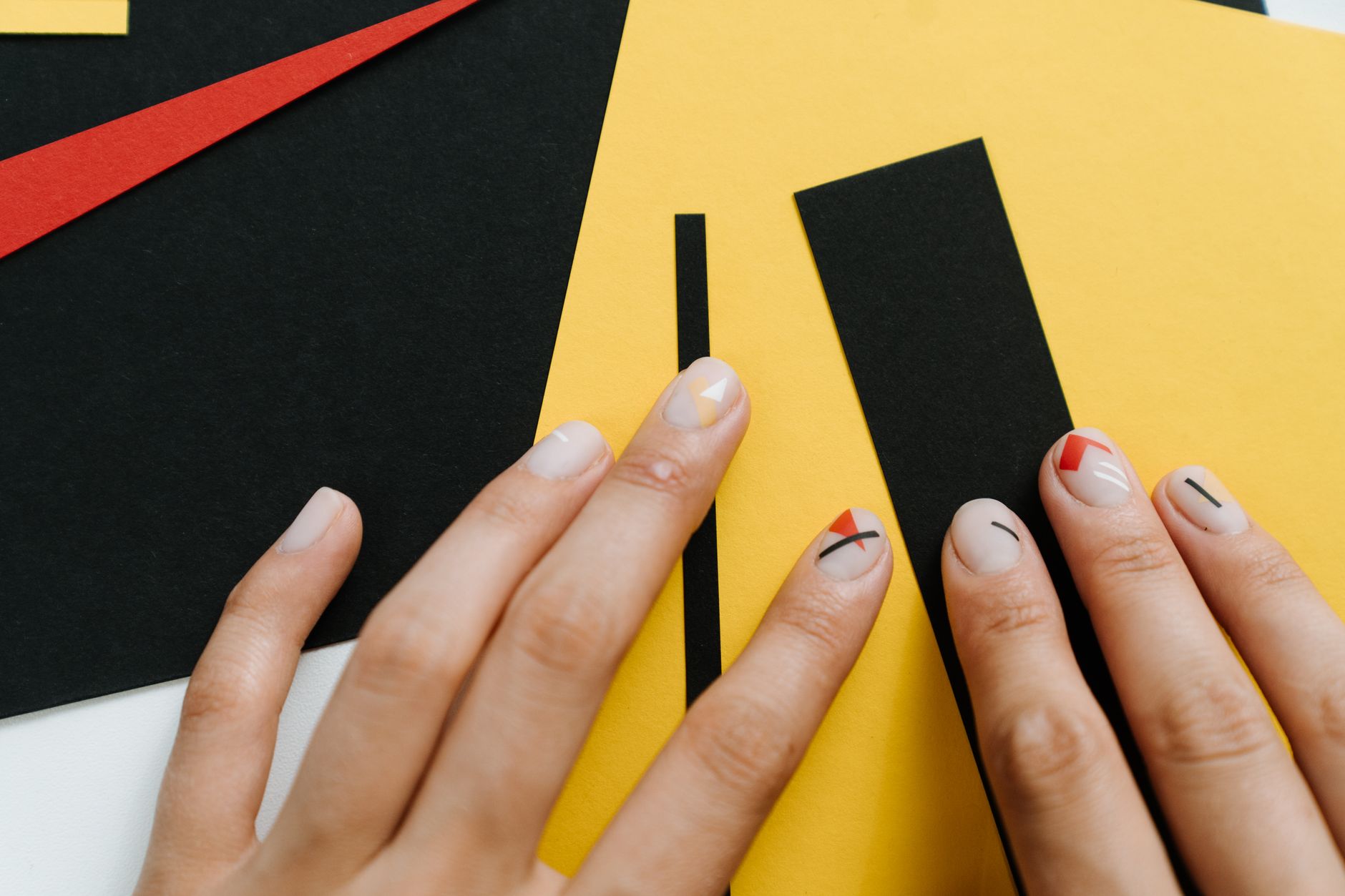
Character work, lettering, and miniatures. Small portraits, cartoon characters, names, dates, tiny scenes. The most demanding category. Genuine fine-art skill is usually evident or absent; reference work in the artist's portfolio is the most reliable signal.
Seasonal and themed. Christmas motifs, Halloween scenes, Easter pastels, summer fruit, autumn leaves. Often done as accent work; many artists keep a small repertoire of seasonal designs they can produce confidently.
Who it's for
Hand-painted nail art can be a good choice when:
You want a unique, personal design rather than something everyone else has.
You have a specific reference image in mind — an artwork, a fabric pattern, a photograph — and want it interpreted on your nails.
You're booking for an event, a photoshoot, or a special occasion where the extra detail will be appreciated and noticed.
You enjoy the process of working with an artist on something custom, including sitting through a longer appointment.
You're confident the artist you've chosen has demonstrated skill in the specific style you want.
It tends to be less ideal when:
You need a quick appointment or have limited patience for a long sitting.
You want exact uniformity across all ten nails. Hand-painted designs have natural variation; if precision uniformity matters more than artistic interpretation, stamping or decals can be more reliable.
Your budget is limited. Custom painted work tends to cost meaningfully more than standard manicures.
You haven't seen recent portfolio work in the style you want. Hand-painted skill varies so much by artist that booking blind carries real risk.
How long it takes
Time depends primarily on complexity and how many nails carry detail.
A small accent design on one or two nails typically adds around 30 to 60 minutes to the appointment.
Moderate work — designs on four to six nails, or a single elaborate piece — typically adds 60 to 120 minutes.
Full-set detailed work, or a single large miniature painting, can add 120 to 180 minutes or more.
Plan for the full appointment to run two to four hours total when ordering custom hand-painted work, and confirm the time estimate with the artist before booking.
What it costs
Prices below are approximate ranges as of 2026. Treat them as orientation rather than authoritative; check with the specific salon for current pricing. Hand-painted nail art is one of the more variable categories — pricing depends on the artist's experience, the complexity of the design, and how many nails carry detail, so a flat-rate figure rarely tells the whole story.
In Bucharest, modest hand-painted accent work tends to add roughly 80 to 150 RON to the underlying manicure. Moderate to detailed work commonly adds 150 to 300 RON. Highly elaborate full-set work, miniature paintings, or signature work by well-established nail artists can cost more again.
Outside Bucharest, prices generally trend lower, with smaller cities often 20 to 35% below.
Some salons charge per nail with detail rather than as a flat upgrade, which can be more transparent for partial designs. Worth asking how the salon prices custom work before committing.
What to ask your artist
Portfolio is the most important thing to check, and it matters more here than for almost any other technique.
Can I see recent hand-painted work in the style I want? This is the question. An artist with a beautiful floral portfolio may not be as comfortable with geometric work, and vice versa. Don't assume general nail-art skill transfers across styles.
Is the work in your portfolio yours, or shared from a course or another artist? Some social media portfolios mix in inspiration images and course samples. Worth asking which posts are the artist's own work.
Can I bring reference photos? Reference photos are essential for hand-painted work. Most artists welcome them. A clear photo helps clarify the colour palette, level of detail, and overall mood you're after, all of which are difficult to describe in words.
Will you draw exactly the reference, or interpret it? Some artists copy as closely as possible; others adapt the design to their own style. Both can produce beautiful work, but it helps to know which you're getting.
How long do you estimate this will take? A realistic estimate sets expectations. Significant underestimation may suggest the artist hasn't done similar work recently.
What's your approach if the design isn't working partway through? Hand-painted work is harder to reverse than other techniques. A confident artist usually has a plan for adjustments, repaints, or simplification if the original design isn't coming together.
If the first nail looks meaningfully different from your reference, mention it before the artist moves on. Adjustments mid-appointment are much easier than corrections after the design has been sealed under top coat.
Care between appointments
Same general practice as any gel-based service. Daily cuticle oil, gloves for cleaning, no picking, no using nails as tools. For broader maintenance practices that help nails recover and stay healthy, see healthy nails fundamentals.
Two extra points specific to hand-painted work:
The top coat over the design takes the wear that the design itself would otherwise take. If the gloss starts looking dull at week two, a fresh top coat refresh can restore the shine and add a small layer of protection over the painted detail. Some Romanian salons offer this as a quick mid-cycle service.
Avoid acetone-based products on the painted surface (some hand sanitisers, some nail-strengthening treatments). Repeated acetone exposure may dull the gel paint or thin the top coat over the design.
Common questions
How is hand-painted different from stamping or decals?
Stamping uses an etched metal plate to transfer a pre-designed pattern onto the nail. Decals are pre-printed images applied like a sticker. Hand-painted work is drawn directly onto the nail by the artist with brushes and gel paint. Stamping and decals tend to be faster, cheaper, and more uniform; hand-painted work tends to be more bespoke, more variable, and more expensive.
Will all ten nails look identical?
Generally close in skilled hands, but not perfectly identical. Hand-painted work has inherent variation between nails, and that variation is often considered part of the appeal. If exact uniformity matters more than artistic interpretation, stamping or decals can be a better fit.
Can the design be repaired if a nail chips?
Sometimes. Small chips at the edge can often be touched up with fresh gel paint and resealed. Larger damage usually requires the painted design on the affected nail to be redone. Worth asking your salon about their policy on touch-ups before booking.
Can I do hand-painted nail art at home?
Possible, but the learning curve is steep. Gel paint, fine brushes, and a curing lamp are accessible, but the skill component takes practice. Home results often look like home results; for events or designs that matter, salon work tends to be worth the cost.
Does hand-painted work last as long as plain semi-permanent?
Wear life is typically the same as the underlying service — two to three weeks for semi-permanent, three to four weeks for gel construction. The painted detail itself is sealed under top coat and tends to hold up alongside the base.
Will hand-painted work damage my natural nails?
Not directly. The damage commonly attributed to gel-based services tends to come from poor removal rather than from the painted layer. Standard removal practice applies. For removal mechanics, see safe gel removal.
Bottom line
Hand-painted nail art can be a good choice when you want something custom, personal, and visibly made by hand rather than printed. It is the most artist-dependent technique in this knowledge base, and the practical implication is straightforward: portfolio work in the style you want is the most useful signal. Bring reference photos, plan for a longer appointment, and expect pricing to vary with complexity. Done well by a skilled artist, hand-painted nails tend to be one of the more memorable and photogenic finishes in modern Romanian salons.