
Decor
9 min read
Swarovski crystals and rhinestones

By Andreea Mădălina
Founder, Fata cu unghiile
Crystals are a frequently requested decoration in Romanian salons, especially for events and bridal work. A few well-placed stones can turn a basic manicure into something that catches light, photographs beautifully, and feels considered. Done badly, the same stones can look gaudy or fall off within days. The difference tends to come down to application technique and the quality of the products used.
This article covers what crystals are, the difference between Swarovski and alternatives, how application works, what to expect on cost (which can vary more than for many other decorations), and how to make sure your crystal manicure actually lasts.
What they are
Crystal decorations on nails are small faceted stones glued onto the polish or set into the gel layer during construction. One of the more well-known brands is Swarovski, an Austrian company whose precision-cut crystals have long been considered a high-quality option for nail decoration. Several other manufacturers (Asfour, Preciosa, generic suppliers) produce stones of varying quality at lower price points.
The defining features of higher-quality stones tend to be:
Precise faceting that creates consistent light reflection across all sides.
Uniform size within a stated grade (an SS9 stone should be roughly the same diameter as every other SS9 stone).
Backing that holds the foil mirror coating without flaking or bubbling.
Colour that holds up reasonably well over time without obvious fading or shifting.
Lower-quality crystals can look acceptable on day one but may yellow, dull, or lose their backing within weeks.
The "SS" sizing convention (used universally) refers to the stone diameter in 1/64-inch increments. Common nail sizes:
- SS3 — about 1.4 mm. Tiny accent stones.
- SS5 — about 1.8 mm. Most common for general placement.
- SS9 — about 2.6 mm. Statement-size stones.
- SS12 — about 3.2 mm. Bold accent.
- SS16+ — large stones, used sparingly for dramatic effect.
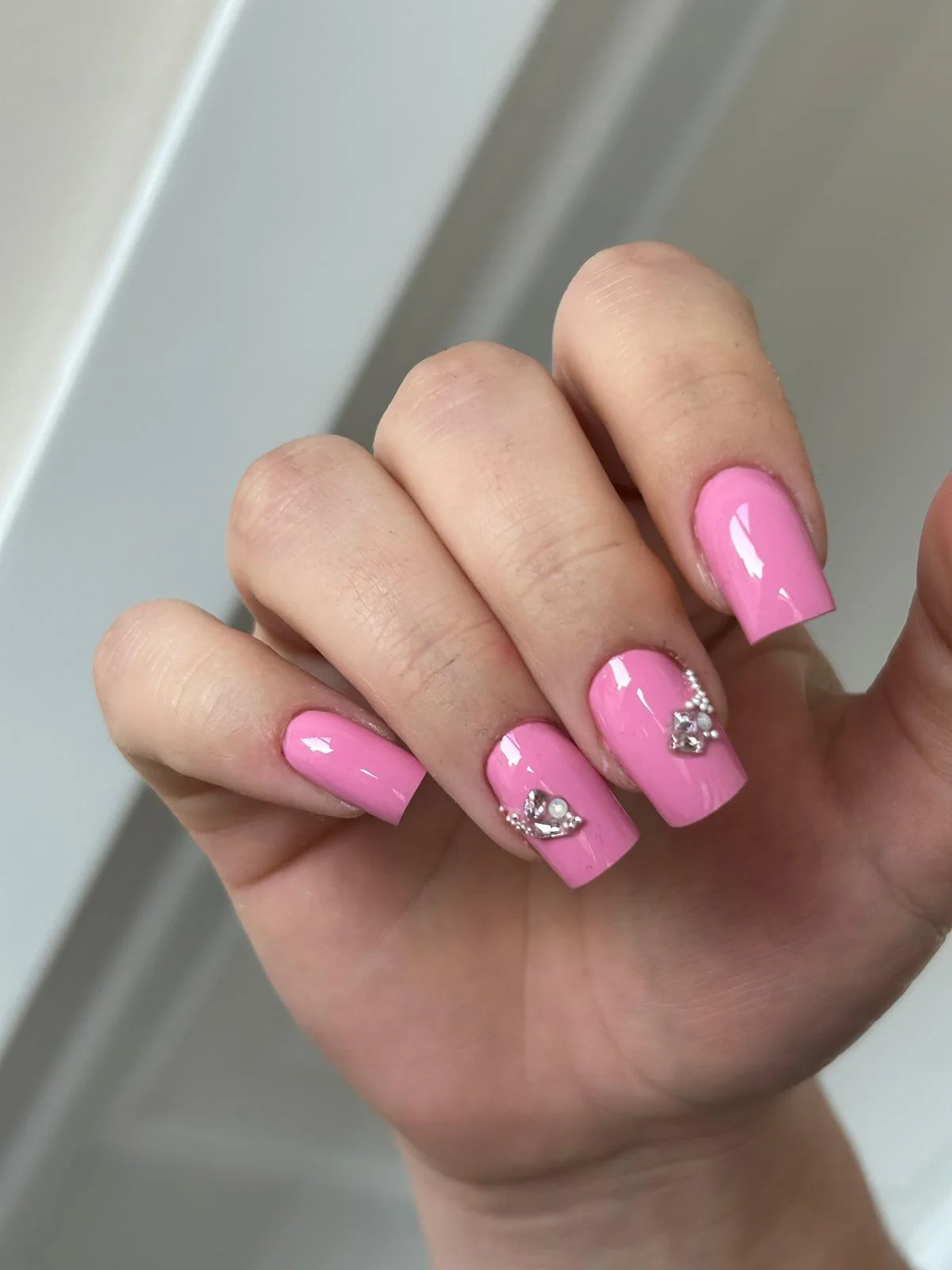
A typical accent placement uses 2-6 SS5 or SS9 stones per accent nail. Full coverage uses dozens of SS3 stones.
Application techniques
Two common methods:
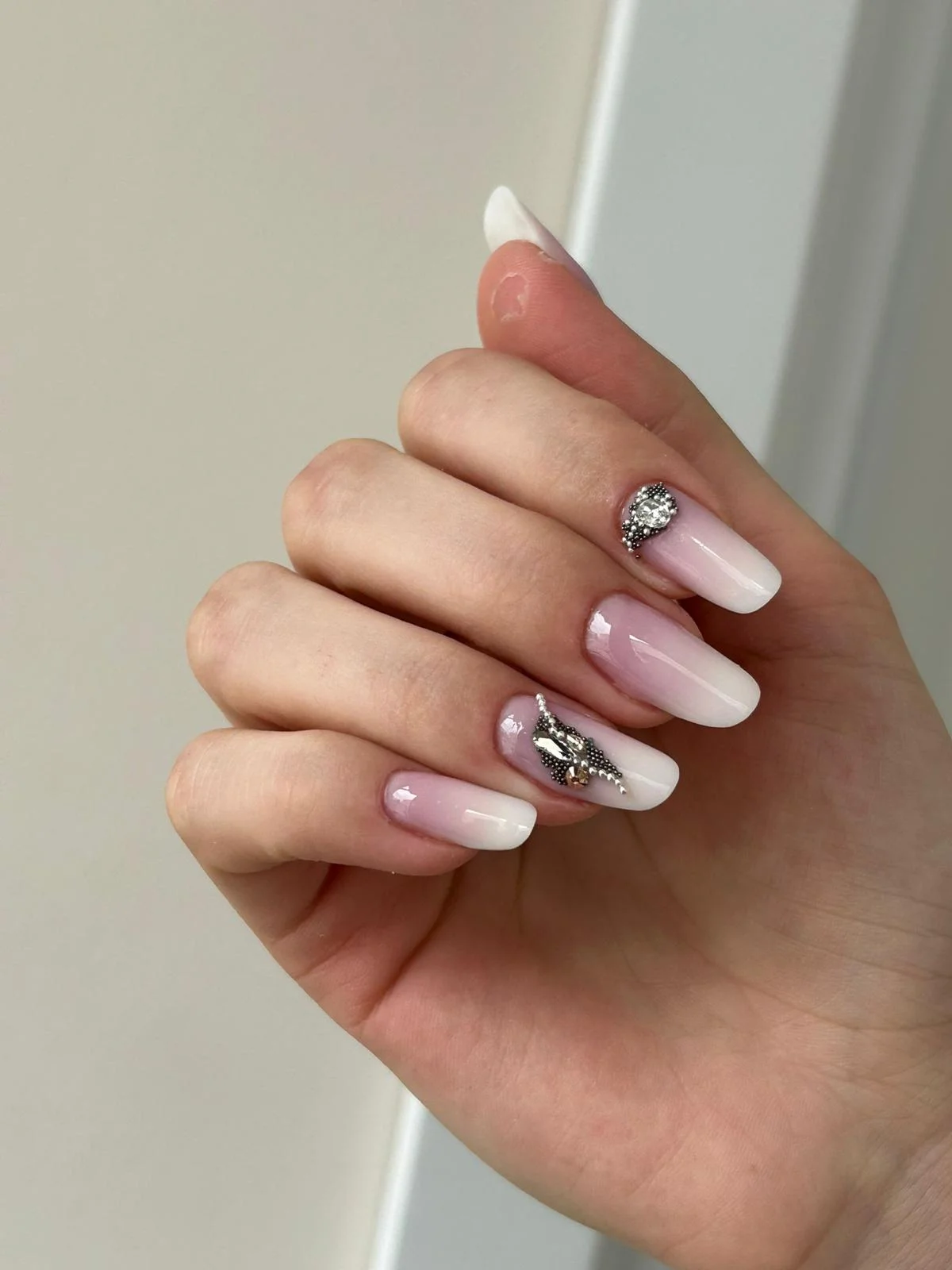
Surface application — A small drop of clear gel is placed where the stone will go. The stone is positioned on the gel with tweezers or a picking tool. The gel is cured under the lamp, fixing the stone in place. A clear top coat goes over the stone area to seal the edges. Standard for most decorative work; the stone sits slightly raised above the nail surface.
Encapsulated application — The stone is set into a layer of clear gel during construction. A subsequent gel layer covers the stone, then more gel builds the surface to be flush. The stone is fully embedded under the gel surface. More durable (the stone can't catch on fabric and pop off), more elaborate to apply, used for bridal and high-stakes work where catching is a concern.
Surface application tends to be more common because it's faster and the stones can look more dimensional. Encapsulation is generally more durable but tends to flatten the visual effect.
Either method requires precision. Stones placed in gel that hasn't been mixed properly, or in gel that's too thick or too thin, can fall off within days. Experienced artists tend to know the right viscosity and amount for the stones they're working with.
How long they last
A well-applied crystal manicure should generally last as long as the underlying service:
Surface-applied crystals on semi-permanent: typically 2-3 weeks, comparable to the polish life.
Encapsulated crystals in gel construction: typically 3-4 weeks, comparable to the gel life.
Crystals applied with poor technique can fall off within hours or days. Common causes include:
Insufficient gel under the stone (not enough adhesion).
Gel applied to a glossy top coat without scratching the surface (poor bond).
Stones placed at the very tip or edge of the nail where they tend to catch on everything.
Cheaper stones whose backing flakes during cure.
If a stone falls off, the underlying clear gel often shows where it was, sometimes with a small bump. Many salons will replace a stone at no charge if the loss happens within a few days, though policies vary — worth asking before booking.
Pricing in Romania
Prices below are approximate ranges as of 2026. Treat them as orientation rather than authoritative; check with the specific salon for current pricing.
Crystal pricing tends to be one of the more variable categories in nail services. Several factors affect cost:
The brand of stone. Authentic Swarovski crystals typically cost meaningfully more than generic alternatives. Some salons charge per Swarovski stone; others charge a flat fee for limited stone work.
The number of stones. Per-stone pricing tends to be more common at upmarket salons. Flat fees are more common at budget salons.
The size of the stones. Larger stones (SS9+) typically cost more than smaller ones (SS5), sometimes substantially so.
The placement complexity. A single accent on one finger generally adds little to the bill. Elaborate full-coverage designs across all ten nails can add a meaningful sum to the appointment.
Whether stones are surface-applied or encapsulated. Encapsulation requires more gel and time, and tends to cost more.
In Bucharest as of 2026, typical pricing roughly falls into these ranges:
Single small accent (1-2 SS5 stones on one nail): often around 5-15 RON added to the manicure.
Modest accent (4-8 SS5 or SS9 stones across two or three nails): often around 30-80 RON added.
Full-coverage on one or two nails: roughly 60-150 RON added.
Bridal-level work with many stones across all nails: 150-300 RON added is common.
Who they're for
Crystals can work well for:
Special events. Weddings, parties, photoshoots, birthdays, where extra detail matters.
Anyone who likes statement nails. Crystals tend to be flexible across varying levels of statement.
People who photograph their nails. Crystals can catch light nicely and tend to look striking on Instagram.
Subtle accent style. A few small stones on one finger often reads as elegant rather than over-the-top.

Daily intensive use. Crystals can pop off during heavy hand use, especially without encapsulation.
Tight-fitting clothes or fabrics. Crystal-covered nails can snag on textures.
Hands-in-water work. Frequent water exposure may shorten crystal adhesion.
Conservative environments. Some workplaces consider visible crystals unprofessional; depending on your industry, full-coverage crystal designs may be a step too far.
What to ask your manicurist
Specific questions for crystal work:
Do you use authentic Swarovski or generic stones? Worth asking. Pricing should generally reflect the answer.
Do you set them surface or encapsulated? If you want maximum durability for a wedding or event, encapsulation tends to be more reliable. If you want maximum visual effect, surface application often shows the stones more dimensionally.
How do you handle a stone that falls off? Many salons will replace stones that fall off within a short window. Policies vary, so worth confirming up front rather than assuming.
Can I see recent crystal work in the style I want? Crystal placement is taste-dependent and skill varies by style. An artist who excels at scattered accent crystals may not be as practised at structured French-line crystals.
How many stones should I plan for what I'm describing? If you're not sure of the quantity, the artist can usually advise based on proportions they've seen on previous clients.
If you have specific stones you've bought yourself (some clients bring their own crystals), confirm that the salon will work with them. Some salons only use their own stock.
Care between appointments
Same as the underlying service, with extra attention to the crystal areas:
Cuticle oil daily, but avoid getting oil directly on the crystals where possible. The oil can dull the reflective coating slightly over time.
Be aware of the crystals when handling things. Don't lever objects with the decorated nails; the stones can pop off under stress.
If a crystal falls off in the first few days, contact your salon. Many will replace it; policies vary. Don't try to glue it back on at home; consumer glue isn't the same chemistry as gel and the repair tends not to last.
If a crystal looks dull at week two, a fresh top coat over the surface can restore some shine.
Common questions
Are real Swarovski crystals worth the extra cost?
For special events, photographs, and bridal work, many people find the clarity and consistency of Swarovski stones noticeably better than generic. For casual everyday wear, generic stones often look fine and the cost difference can be harder to justify.
Can I do crystals at home?
Possible but tricky. Home application kits exist but the gel and the technique aren't typically the same as professional. Home crystals often fall off within days. For occasions that matter, salon work tends to be worth it.
How many stones is too many?
Taste-dependent. A subtle accent (2-4 stones on one nail) reads as conservative. Moderate decoration (10-20 stones distributed) reads as a statement but generally still appropriate. Full coverage (50+ stones) tends to be dramatic and is often most appropriate for events.
Will crystals damage my natural nails?
Not typically in any direct way. The crystals themselves are decorative; damage when it occurs tends to come from poor removal of the underlying gel rather than from the stones. Standard removal practice applies.
Can I get crystals over my own length, or do I need extensions?
Either works. Crystals can look beautiful on natural-length nails as accent work. Larger or more elaborate designs often work better on the additional surface area of construction nails.
What if my nails are too short for crystals?
Even very short nails can usually support a single small accent stone. The size of the crystal tends to matter more than nail length; SS3 or SS5 stones work on short nails.
Can I remove crystals at home if I want them off?
Acetone soak removes the gel that holds the stones, and the stones come off with the gel layer. Salon removal tends to be faster and cleaner.
Bottom line
Crystals can be one of the more versatile decorative options in modern Romanian salons. Quality tends to matter: authentic Swarovski is often a sensible choice for events, while generic stones can be acceptable for everyday wear. Application technique tends to matter more than product choice; stones falling off is often a technique issue rather than a product defect. For special occasions, encapsulation tends to offer durability that surface application can't match. Finding an artist whose crystal work in your preferred style looks consistent across their portfolio is generally the most useful step.