
Care
7 min read
What to do if a nail breaks

By Andreea Mădălina
Founder, Fata cu unghiile
A nail breaks at the worst possible moment, generally. You're getting dressed, reaching into a drawer, and a corner catches on something. Most breaks are fixable, some look worse than they are, and a small minority need medical attention or patience while the nail grows out. This article covers what kind of break you're dealing with, what to do first, and when a salon visit is the right next step.
For the broader basics that reduce the chance of breaks, see healthy nails fundamentals.
Types of breaks
Four common categories:
A free-edge crack. The split is at the white tip, past the fingertip. The nail bed isn't involved. Often a quick file is all that's needed.
A side-wall crack. The split runs along the side, sometimes from the free edge backward. These can deepen as the nail flexes, so they're worth addressing.
A full break that reaches the skin or nail bed. The nail has cracked or torn to where it's attached. This is the kind that bleeds, hurts, and warrants careful handling. A salon may not be the first stop.
Partial lift on a gel or constructed nail. The product has come away from the natural nail at one edge, often without the natural nail itself being damaged. A repair rather than a true break.

Immediate first response
The first few minutes come down to assessing and stabilising.
If the nail is bleeding or skin is broken, treat it as a small wound. Wash gently with soap and water, apply pressure with a clean tissue until bleeding stops, and cover with a small plaster. If bleeding is significant, the pain is sharp, or the break looks deep, medical attention is the next step.
If the break is at the free edge with no skin involved, a quick file across the broken edge often does the job. File in one direction rather than sawing back and forth.
If the break is mid-nail or along the side wall, covering it with medical tape or a Band-Aid until you can get to a salon reduces the chance of deepening.
If gel or product has lifted but the natural nail is intact, resist peeling it off. Pulling can take some of the natural nail surface with it. Tape over the lifted area is the safer bridge.
The common thread: stabilise rather than fix.
When to see a salon
A salon visit usually makes sense if the break is deeper than filing can smooth, if a gel or constructed nail has cracked or lifted significantly, or if it's on a nail that's part of a time-sensitive manicure.
A break that involves the skin or nail bed, bleeds meaningfully, or is painful enough to interfere with daily use isn't a salon-first situation. A doctor or pharmacist is a more useful first stop. Most careful manicurists will redirect you if a break looks like it needs medical attention before cosmetic work.
What the salon will do
Small breaks at the free edge. The manicurist files the affected nail to a stable shape, sometimes shortening matching nails for balance.
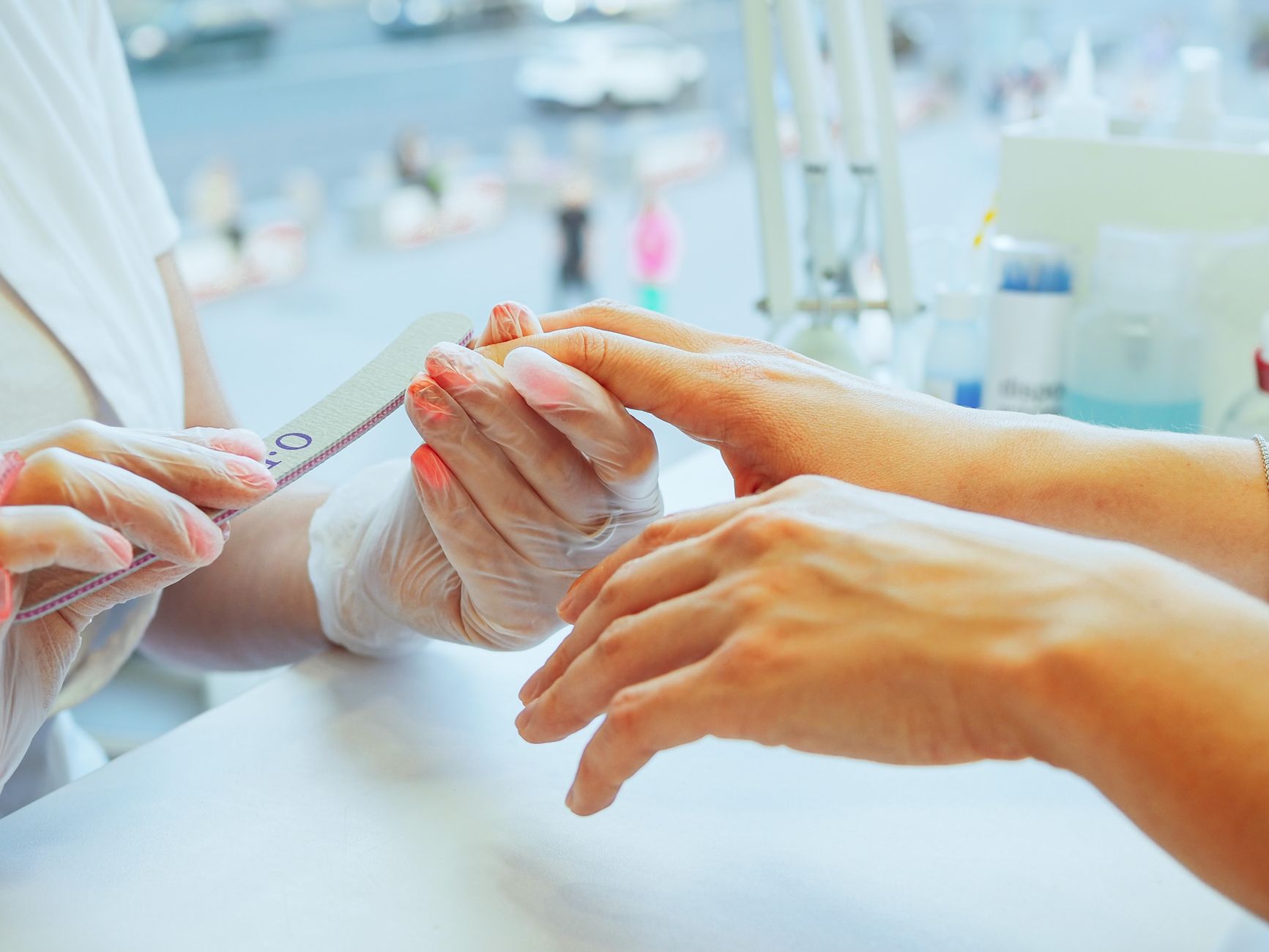
Severe breaks where the natural nail has split too far down to save. A tip-and-overlay (a plastic tip glued on and covered with gel or acrylic) gives length and stability while the nail grows out underneath. More involved than a quick gel fix.
Partial lift. The manicurist files off the lifted product, preps the nail underneath, and rebuilds the section with the same gel system used originally.
Many salons offer quick single-nail repairs, sometimes same-day or next-day, but availability and pricing vary. Worth calling ahead.
Self-fix tips
If a salon visit isn't immediately possible and the break is small enough for home repair, a few bridge options:
Silk wrap. A small square of silk or fibreglass mesh, glued over a crack, can hold the nail together until proper repair. Cut slightly larger than the crack, apply a thin layer of nail glue, press the silk into place, seal with a second thin layer, and file smooth once cured. Pre-cut silk wrap kits are available from beauty-supply retailers.
Nail glue with care. Cyanoacrylate nail glue can hold a small crack closed temporarily. Avoid getting glue on skin or cuticle, since it bonds quickly and removing it can pull skin. Never glue a nail back onto skin if a piece has torn off in a way that exposes the nail bed — that's a medical situation. Ordinary household super glue is a different formulation and not generally recommended for direct nail use.
Tape or plaster. Without repair supplies, medical tape or a small plaster keeps the nail from snagging.
These are bridges, not full solutions.
When not to self-fix
Home repair isn't the right call when:
- The break involves broken skin, exposed nail bed, or active bleeding. Gluing or filing over an open wound can trap bacteria.
- Signs of infection appear — increasing redness, swelling, warmth, pus, or pain growing over a day or two. These warrant a doctor's visit, particularly with an underlying condition like diabetes that affects healing.
- The nail has partially detached from the nail bed. A doctor or experienced practitioner should assess this; gluing it back can cause more harm than benefit.
If you can't tell whether something is cosmetic or medical, a brief check with a doctor or pharmacist clarifies a lot.
Costs at the salon
Prices below are approximate ranges as of 2026. Treat them as orientation rather than authoritative; check with the specific salon for current pricing.
A single-nail repair in Bucharest typically falls in the range of 40 to 100 RON — a quick file at the low end, a builder gel rebuild mid-range, a tip-and-overlay at the higher end. If the repair happens within a fresh manicure appointment, some salons fold it into the service price; others charge a small additional amount. Outside Bucharest, prices generally trend lower, with smaller cities often 20 to 40% below.
Some salons will redo a broken nail at no charge if the break happens within a few days of the original appointment and looks application-related. Many won't. It's reasonable to ask the salon's repair policy rather than assuming.
Care while waiting
Keep the nail covered with tape or a plaster to prevent catching. Apply cuticle oil around the area as normal. Avoid using your hands as tools — opening cans, peeling labels, and scraping put levering force on the broken nail. Trim or file the matching nails on the same hand shorter so the broken one isn't bearing more pressure than the others. Skip aggressive hand washing where you can; brief washing with gentle soap is fine.
Common questions
My nail tore off completely. What do I do?
The priority is the exposed nail bed, which is sensitive and at risk of infection. Wash gently, cover with a clean dressing, and see a pharmacist or doctor if there's significant bleeding, pain, or sign of infection. The nail will grow back from the matrix over six to twelve months.
Can I just leave a small crack alone?
Sometimes, particularly if it's a shallow crack at the edge. The risk is it catches and deepens before it grows out. Filing smooth and covering with top coat or tape is safer than ignoring it.
My gel manicure has a hairline crack but no break in the nail. Should I worry?
A hairline crack in the gel layer alone usually doesn't need urgent action, but it can deepen. Worth flagging at your next appointment.
Are some nail shapes more prone to breaking?
Longer and more pointed shapes catch on things more often than shorter, rounded shapes. Builder gel construction can compensate for some of the structural fragility of longer shapes.
Bottom line
Most broken nails are fixable, either at home for the small ones or at a salon for the rest. Breaks that need medical attention are usually obvious from the bleeding, pain, or skin involvement. Stabilise first, assess the type of break, and let it guide whether the next call is to a salon or a doctor.
For the maintenance practices that help nails stay resilient, see healthy nails fundamentals and maintenance between appointments.