
Decor
9 min read
Encapsulated designs

By Andreea Mădălina
Founder, Fata cu unghiile
Encapsulated work sits in a quiet corner of decorative nail art that rewards patience. Instead of placing decoration on top of a finished nail, the artist sets it between gel layers and seals the design under clear gel, so the petals, glitter, or foil sits below a smooth glassy surface. The effect is sometimes called the aquarium look, and it tends to last longer than the same decoration applied at the top.
This article covers what encapsulation is, the materials that suit it, how the process generally works, what to expect on durability, and the cost range to plan for. For the broader gel-construction technique that often underpins encapsulated work, see the gel construction article.
What it is
Encapsulated design refers to any decoration placed inside the gel layers of a manicure rather than on the surface. A typical structure has a base coat, a colour or sheer layer, then the decoration set into a thin layer of clear gel, then one or more clear gel layers built over the top, then a top coat. The decoration ends up suspended in the build, visible through clear gel from above.
The defining feature is that nothing about the design sits proud of the surface. Run a finger across an encapsulated nail and it feels smooth, with no edges to catch on fabric. Compare that to a surface-applied flake or stone, where the decoration sits on the polish with a clear top coat sealing only its edges. The difference shows up most over time: encapsulated decor is protected from the daily wear that tends to lift and dull surface decoration.
The technique sits naturally inside gel construction work, where multiple gel layers are already part of the build. Encapsulation in semi-permanent is possible but less common, since semi-permanent layers are thinner and leave less room for decoration without bulking the nail.
In Romanian, the technique is usually called design încapsulat or simply incapsulat — both forms come up in salon menus and on Instagram.
Common encapsulation materials
A few materials suit this technique particularly well.
Dried flowers. Pressed and dried small blooms, sometimes whole, sometimes just petals. Baby's breath, daisies, forget-me-nots, and other delicate florals show up most often. The flowers need to be properly dried and flat enough to sit under a thin gel layer; freshly pressed flowers can hold moisture that interferes with the cure.
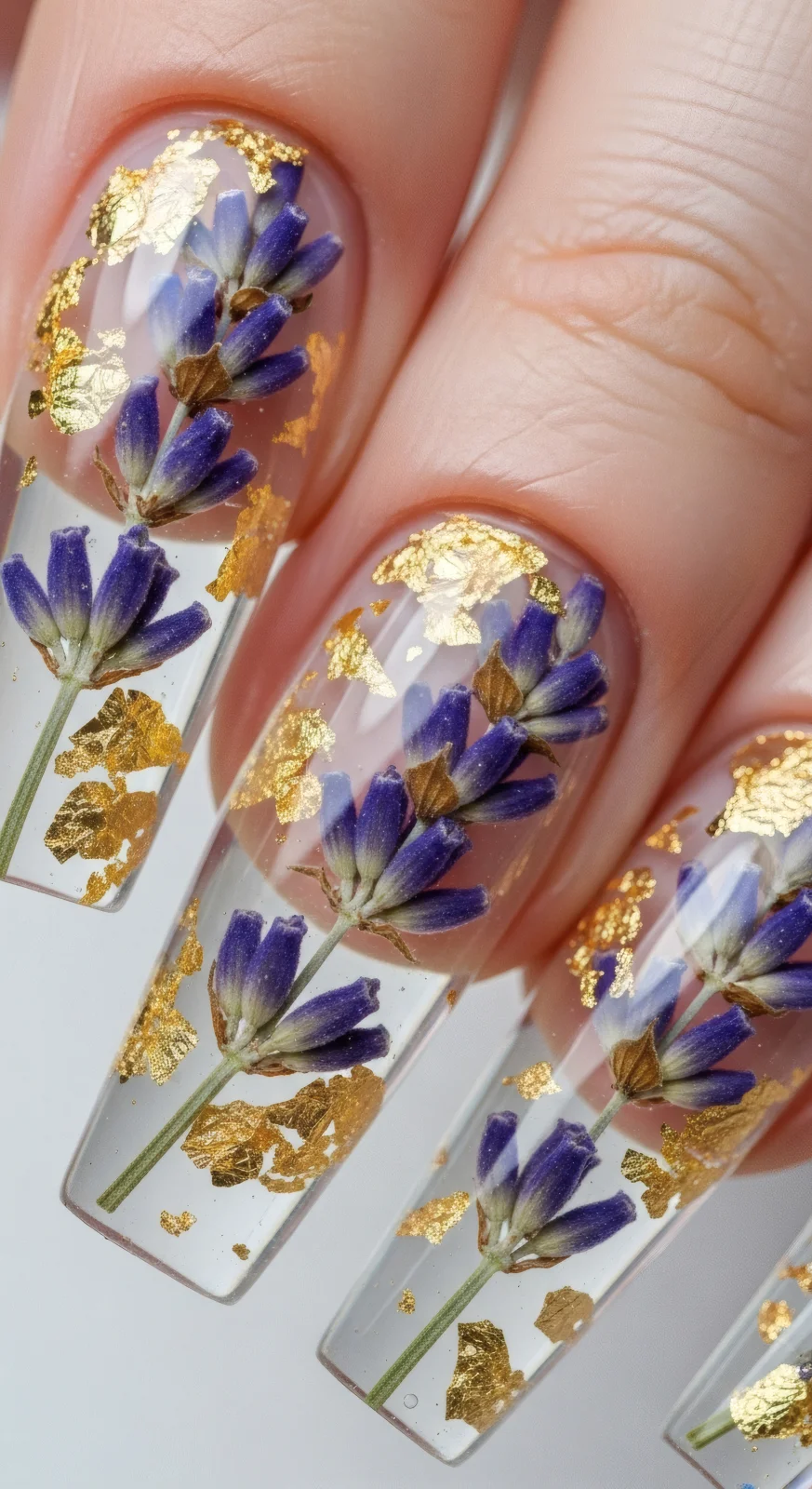
Gold and silver foil flakes. Small irregular pieces of metallic leaf, similar to the flakes used for surface gold-foil work but set inside the build. Encapsulated foil tends to read as more refined than surface foil, with the metallic catching light through the gel rather than sitting on top.

Pigments and mica. Loose powdered pigment dusted into a tacky gel layer and then sealed produces a soft glow rather than visible pieces. Sits between encapsulated flake work and chrome in finish.
Less suitable: anything thick, bulky, or moisture-laden. Fresh flowers, large beads, dimensional 3D elements, and anything that won't sit flat under a thin gel layer tends to either crack the build or leave a lump.
How it's done
The process typically runs alongside a gel construction or filled gel manicure rather than as a separate service.
The artist preps the nail as usual, applies a base, and builds up the first gel layers to set the shape. Once the base build is partly cured and the surface is tacky, the decoration goes on. Flowers and foils get placed with tweezers; glitter and pigments get sprinkled or brushed on. Position matters at this stage because the design will be sealed in shortly.
A thin clear gel layer goes over the decoration to fix it in place, then cures under the lamp. From there, one or two more clear gel layers build up the surface so the decoration sits clearly below the top, with enough gel above to protect it from wear. The artist often files and refines the surface after curing to get a flat, smooth finish, then applies a top coat for shine.
The full process usually adds 15 to 40 minutes to a standard gel construction appointment, depending on how detailed the design is. A single dried flower on one accent nail goes faster than scattered floral work across all ten.
Common technical points: the gel viscosity matters, since gel that's too thick can shift the decoration during cure, and gel that's too thin doesn't hold the design in place. Cure times for the encapsulating layers tend to be slightly longer because the layer is thicker than a colour coat. Experienced artists tend to know how much gel a particular decoration needs to sit cleanly without bulking the nail.
How long it lasts
Encapsulated work tends to outlast the same decoration applied at the surface. The protective gel layers above the design carry the wear that would otherwise hit the decoration directly. Glitter that would scratch and dull on the surface stays bright; foil flakes that would lift at the edges stay sealed; flowers that would crush under daily handling stay intact.
In practice, encapsulated decoration usually holds for the full life of the underlying gel construction — typically three to four weeks before maintenance, sometimes longer. The gel build itself tends to be the limiting factor rather than the decoration. Compared to surface decor, which can dull, lift, or chip well before the underlying service needs work, encapsulated designs generally hold up across the full cycle.
The main failure mode is a bubble or shift introduced during application; a flower that wasn't fully flat or glitter clumped unevenly will stay that way for the life of the manicure.
Who it's for
Encapsulation tends to suit a few specific situations.
Long-wear decoration. Anyone who wants the look of decorative work without the surface decor lifting or dulling within a week. Encapsulation is the more durable option when the decoration matters for the full life of the manicure.
Hands-on work. Cooking, cleaning, gardening, and other daily activities are kinder to encapsulated designs than to surface decoration. The smooth surface doesn't catch on fabric, and the decoration is shielded from daily wear.
Wedding and event work. When the look needs to hold for several days through a tightly scheduled week, encapsulation tends to be more reliable than surface application, particularly for delicate elements like dried flowers.
Quieter aesthetics. The aquarium effect tends to read as elegant rather than flashy. The decoration is present but understated, sitting below a clean glassy top.
It tends to be less ideal for very short or thin nails where the additional gel layers can feel chunky, for clients who want the dimensional, textured look of surface decor, and for casual budgets where the time investment may not justify the cost over a simpler surface application.
What it costs
Prices below are approximate ranges as of 2026. Treat them as orientation rather than authoritative; check with the specific salon for current pricing.
In Bucharest, encapsulated design typically adds 60 to 180 RON to the underlying manicure, depending on complexity. A single small element on one accent nail sits at the lower end of that range; multi-nail floral work or detailed glitter and foil compositions sit at the upper end. The price reflects both materials and the additional time the technique requires.
Outside Bucharest, prices generally trend lower, with smaller cities often 20 to 35% below.
For comparison, encapsulated work tends to cost more than basic surface foil or scattered glitter, since it adds time to the build and uses more gel. It can sit close to crystal-application pricing when the design is detailed, though crystal pricing varies more sharply with the brand and quantity of stones. Where the underlying service is gel construction, the encapsulation is sometimes priced as part of the service rather than as a separate add-on.
Care between appointments
Same general aftercare as the underlying gel construction. Daily cuticle oil, gloves for cleaning, no using nails as tools.
Specific to encapsulated work: the smooth top surface is the protective layer, so anything that scratches the surface gradually exposes the decoration to dulling. Hand sanitiser, particularly the high-alcohol kinds, may slightly haze the top coat over time. If the surface starts to look tired in the third or fourth week, some salons offer a fresh top coat refresh, though policies vary.
Avoid filing the surface yourself; the gel above the decoration is what keeps the design protected, and thinning it shortens the life of the manicure. If a section appears to be lifting or you can see an air pocket, contacting the salon for a fix tends to be more reliable than waiting it out.
For the broader nail-care basics, see healthy nails fundamentals.
Common questions
Are the flowers real?
The dried flowers used in encapsulation are typically real flowers that have been pressed and dried for nail use, sold by specialty suppliers. Some artists dry their own. Synthetic alternatives exist and can look very similar; for most purposes, the visual difference is small.
Will it feel chunky on my nails?
The build does add a little thickness compared to a plain gel manicure, since the design needs gel above and below it. A skilled artist tends to keep the addition modest, and a well-shaped nail usually wears evenly. On very short or thin natural nails, the extra build can feel more noticeable.
Can I do encapsulation on semi-permanent rather than gel construction?
Possible but less common. Semi-permanent layers are thinner, which leaves less room for decoration without the surface feeling textured. Most encapsulated work happens inside a gel construction or filled gel build where there's already several layers to work with.
Will the flowers fade?
The dried flowers used in nail encapsulation are colour-stable for the life of a typical manicure. UV exposure from the lamp during cure and from sunlight afterwards is generally not enough to noticeably shift the colour over three to four weeks. Longer-term storage of dried flower stock can affect colour; that's a salon-side question.
Can I remove encapsulated work at home?
The same removal applies as for the underlying gel construction. Acetone soak softens the gel layers, and the decoration comes off with the gel. Filing through the build first is usually needed because of the thickness. Salon removal tends to be faster and cleaner; for the broader removal mechanics, see safe gel removal.
Does encapsulation damage my natural nails?
Not directly. Any damage that occurs tends to come from poor removal of the underlying gel rather than from the encapsulation itself. Standard gel-construction practice applies.
Bottom line
Encapsulated design can be a good choice when you want decoration that holds up across the full life of a gel manicure rather than dulling or lifting in the first week. The technique sits naturally inside gel construction work and tends to suit dried flowers, fine glitter, and foil flakes particularly well. The smooth glassy finish reads as quietly elegant, and the protected design tends to come through the four-week cycle in good condition. For events, weddings, and wear-heavy daily life, encapsulation often pays off where surface decoration would struggle.