
Shapes
7 min read
Squoval shape nails

By Andreea Mădălina
Founder, Fata cu unghiile
Squoval is a frequently requested shape in Romanian salons, partly because it asks less of the wearer than either of its parents. The silhouette is a square with rounded corners. The flat top keeps the structured, modern look of square, while the softened corners take away most of the catching and snagging that come with sharp angles. It tends to read as tidy and considered without feeling fussy, which is a large part of why many people settle on squoval as their default everyday shape.
What it is
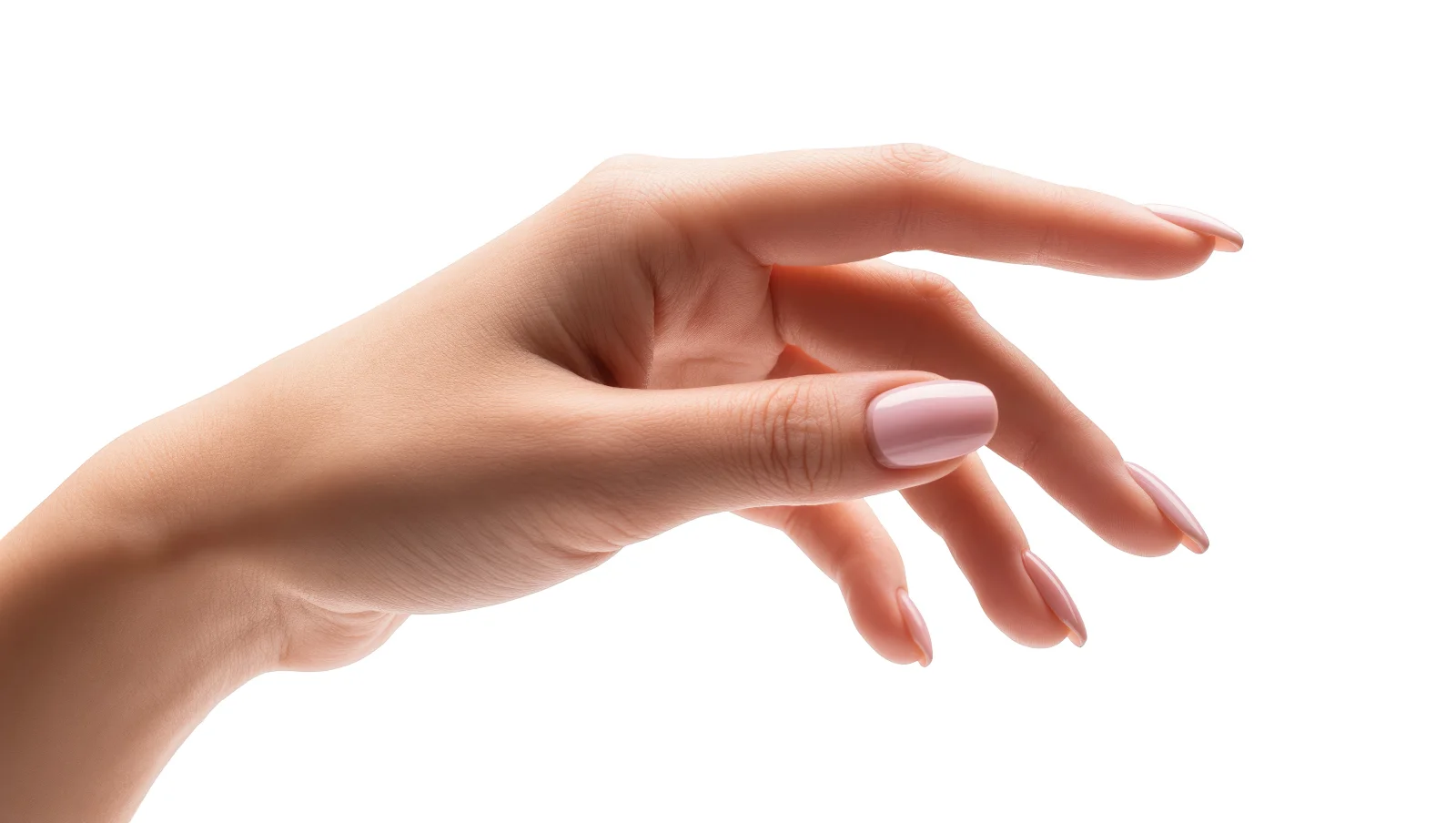
Squoval (the term is a portmanteau of "square" and "oval" and stays as a borrowed word in Romanian as well) is a flat-tipped nail with sides that run roughly parallel from the cuticle to the tip, and corners that are filed into a soft curve rather than left at a sharp angle.
The defining feature is the combination: flat top, parallel sides, rounded corners. Move the corners back to fully sharp and you have square. Round the entire tip and you have oval. Squoval sits in between, keeping the architectural feel of square but losing the points that catch on fabric.
A well-shaped squoval has symmetrical sides, a tip that's flat across the centre but smoothly curved at each corner, and consistent rounding across all ten nails. The amount of corner curve is a matter of taste, ranging from barely-rounded (closer to soft square) to noticeably curved (closer to oval).
How it differs from related shapes
Squoval lives between three close relatives, and the differences are worth knowing.
Square has fully sharp corners. The flat top is identical, but the corners are left at a right angle. More editorial-looking, more prone to chipping at the corners, harder on fabric and hair.
Oval rounds continuously from one side to the other with no flat section at the tip. Softer overall feel, more flowing, less structured.
Almond tapers inward from the cuticle and ends in a soft point. A different family entirely, more elegant and more high-maintenance.
If you like the look of square but the corners keep catching, squoval is usually the next thing to try. If you find oval too soft and round, squoval gives more shape without going fully angular.
Who it suits
Squoval tends to suit a wide range of hand types and is one of the more forgiving shapes to wear day to day.
It works well at medium length, which is generally where it's most distinctive. The flat top has room to develop visually, and the rounded corners read clearly without dominating.
It can suit nail beds that are too short for a clean almond or a long square. The shape doesn't depend on dramatic length to look intentional.
It can suit people who want structure without high maintenance. The rounded corners distribute pressure better than sharp ones, so chipping at the tips tends to be less frequent than with full square.
It can suit hands-on lifestyles where pure square would catch too often. Typing, handling fabric, and routine daily tasks tend to be easier on squoval than on square.
A few cases where it can feel less effective:
On very short nails, the corner rounding can eat into the small amount of free edge available, leaving the shape looking like a clipped natural nail rather than a deliberate squoval. The flat-top reading needs at least a few millimetres of free edge to work.
On very long nails, especially with strong corner rounding, squoval can drift visually toward oval. The architectural feel that square brings starts to soften as the nail gets longer, and at a certain point the eye reads it as a long oval with a slightly flat tip.
On dramatically curved natural nail beds, the flat top can look forced. This is the same constraint that applies to square.
How to ask for it / what to bring
The most useful thing to bring is a reference image at the length and corner-roundness you want. "Squoval" can mean anything from barely-softened square to almost-oval, and showing your manicurist a photo removes the ambiguity in one step.
A few specifics worth mentioning at the appointment:
How rounded you want the corners. Soft, medium, or strong rounding all qualify as squoval, and it's the variable most likely to differ between what you picture and what you get.
Length. Squoval reads differently at different lengths, and it's worth saying whether you want it short and tidy, medium and balanced, or long and structured.
Whether you've had squoval before and how it wore. If sharp-ish corners chipped on you last time, asking for slightly stronger rounding this time is reasonable.
If your manicurist is shaping squoval from a previously square or oval finish, expect the appointment to take a few minutes longer than a routine reshape. Going from oval to squoval usually requires shortening to set up the flat top; going from square to squoval is mostly about the corner curves.

What it costs in Romania
Prices below are approximate ranges as of 2026. Treat them as orientation rather than authoritative; check with the specific salon for current pricing.
Squoval doesn't typically carry a price premium over other standard shapes. The cost is in the underlying service rather than the shape itself, so squoval on semi-permanent runs roughly the same as oval, square, or round on semi-permanent, and squoval on gel construction follows the construction pricing for your length.
A few salons may charge a modest extra fee for shape changes if you're switching from a noticeably different shape and the work takes additional time. This isn't universal and is worth asking about when booking. Outside Bucharest, prices generally trend lower, with smaller cities often 20 to 40% below.
Common questions
Is squoval the same as soft square?
In casual salon language, often yes. Technically, soft square sits at the lighter end of the squoval spectrum, with corners only barely rounded. Strong squoval has more pronounced corner curves. Many manicurists use the terms interchangeably; if it matters to you, bring a reference image.
Will squoval chip less than square?
Generally yes. Rounded corners give fewer catch points than sharp ones, so the most common chipping pattern on square (corner snags) tends to be less frequent on squoval. It's not chip-proof, and other factors like nail strength and day-to-day wear still apply.
Can I do squoval on very short nails?
It can work, but the flat top needs some free edge to read clearly. On very short nails the rounded corners take up most of the available width and the shape can blur into a small oval. If your nails are very short, oval may give a cleaner result.
Is squoval flattering for wide nail beds?
Often yes. The slight rounding at the corners softens the wider proportion, while the flat top keeps the shape intentional. Square can sometimes make wide nails look chunkier; squoval tends to be more forgiving.
How is squoval different from oval?
Oval is rounded all the way across the tip. Squoval has a flat section in the middle of the tip, with rounding only at the corners. The difference is most visible head-on, looking straight at the nail.
Can I do French on squoval?
Yes. The smile line follows the curve of the nail bed regardless of tip shape, and squoval gives a clean, slightly modern frame for French. It's a familiar pairing.
My natural nails grow with a strong curve. Will squoval work?
It can, though the flat top may look slightly forced if the underlying nail is dramatically curved. An experienced manicurist can usually adapt, sometimes by allowing a hint of curve rather than a strictly flat top. If the curve is very strong, oval may sit more naturally.
Bottom line
Squoval can be a good fit for many people who want a tidy, structured everyday shape without the maintenance demands of fully sharp square. It tends to wear well, suits a wide range of hand types, and reads as deliberate without making a strong stylistic statement. If you've never been quite happy with either square or oval, squoval is often the shape that resolves the trade-off. Finding an artist whose squoval work has consistent corner rounding across all ten nails is generally the most useful step.